Reducing fabric waste in the cutting room with better marker efficiency
In most garment factories fabric accounts for 60–70% of the cost of a finished piece. Labour, trims, overhead and profit share what is left. That makes the cutting room the single most important place for cost control in the building, even though it usually has far fewer people than the sewing hall.
Every decision made at the cutting table, from how the patterns are arranged to how the fabric is spread, decides how much of the fabric you paid for ends up in garments and how much ends up in the waste bags. Improving marker efficiency by a few points is one of the fastest ways to put money back into an order.
What marker efficiency means
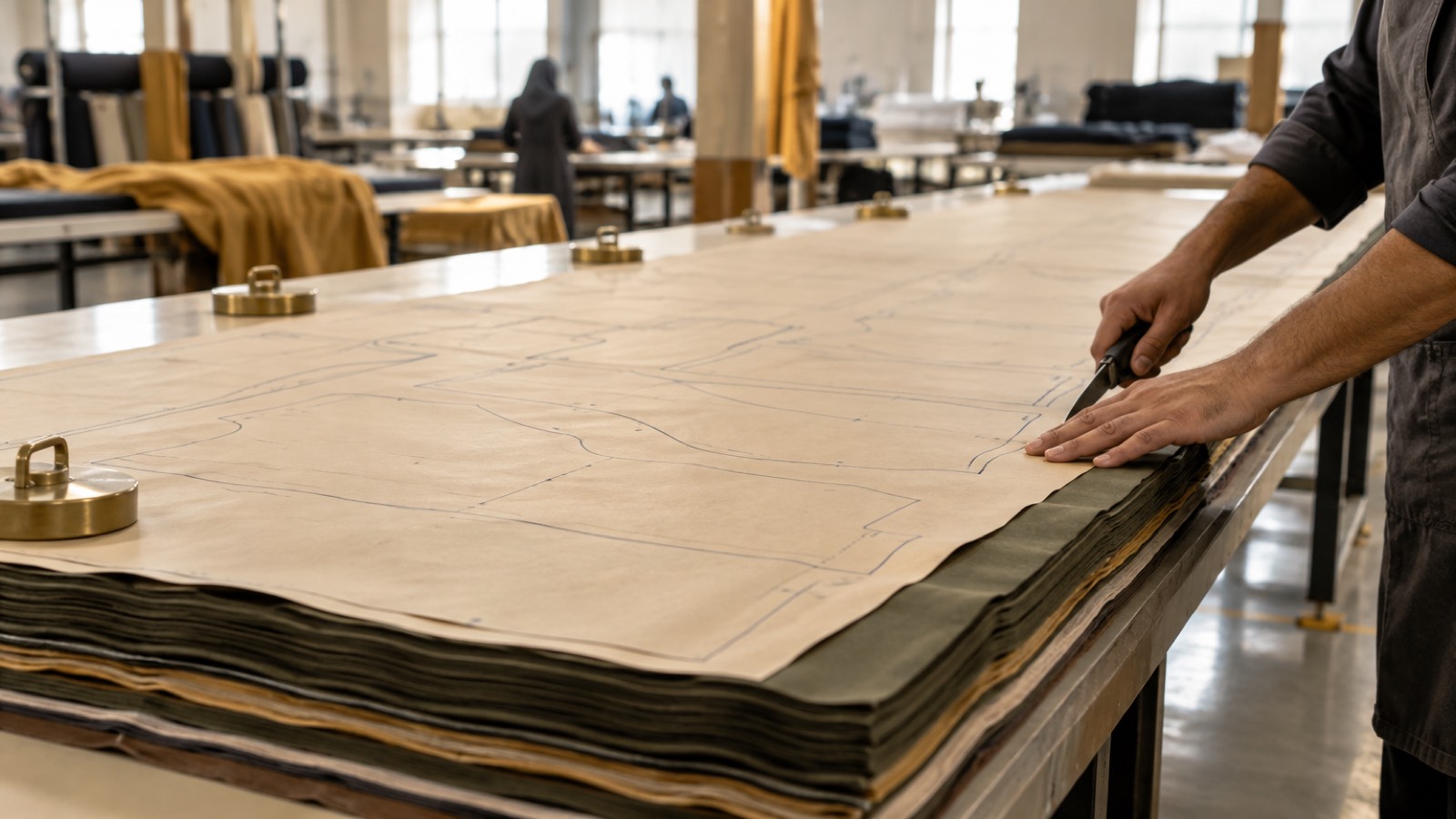
A marker is the layout of all pattern pieces for one or more garments on the width of the fabric. Marker efficiency measures how much of the marker area is used by pattern pieces:
Marker efficiency % = total area of pattern pieces ÷ (marker length × marker width) × 100
If a marker is 6.20 m long and 1.60 m wide, its area is 9.92 m². If the pattern pieces placed on it cover 8.04 m², marker efficiency is 81%. The remaining 19% is the space between and around pieces, which becomes waste on every layer you cut.
Typical values depend on the product. Basic T-shirts and trousers on wide fabric can reach 85–90%. Garments with many small or curved pieces, or with strict grain and pattern-matching requirements such as checked shirts, often sit around 75–82%.
What a few points are worth
Take an order of 10,000 woven shirts with a consumption of 1.40 m per piece at 80% marker efficiency, and fabric at 85 EGP per metre.
| Marker efficiency | Consumption per piece | Fabric for the order | Fabric cost |
|---|---|---|---|
| 80% | 1.400 m | 14,000 m | 1,190,000 EGP |
| 82% | 1.366 m | 13,660 m | 1,161,100 EGP |
| 84% | 1.333 m | 13,330 m | 1,133,050 EGP |
Moving from 80% to 84% saves about 670 metres and nearly 57,000 EGP on a single order, with the same people, the same tables and the same fabric. Over a year of orders the saving can pay for a CAD system several times over. To see how this flows into the final cost of each piece, read our practical playbook for true per-piece costing.
Practical ways to raise marker efficiency
- Combine sizes in one marker. Mixing large and small sizes, for example one L with one S, lets small pieces fill gaps left by large ones. Two- and three-size markers usually beat single-size markers by several points.
- Plan the size ratio before cutting. Splitting the order into lays that match the size breakdown avoids leftover markers with poor efficiency at the end.
- Use the real fabric width. Measure usable width on each lot, not the width on the supplier invoice. A marker made for 160 cm used on 156 cm fabric either wastes a strip or forces a recut.
- Agree on grain tolerances. Where the buyer allows a small tilt on certain pieces, a few degrees of freedom can add one to two points.
- Use CAD where volume justifies it. Automatic nesting is consistently better than manual chalk markers on repeat styles, and makes it easy to compare options.
Waste that is not in the marker
A good marker can still lose money on the table. Other sources of cutting room waste include:
- End losses. The extra length left at each end of a layer. Two or three centimetres per end, on a lay of 80 plies, adds up quickly.
- Splicing overlaps. When a roll ends mid-lay, the overlap between rolls is pure waste if not planned at defined splice points.
- Fabric defects. Holes, stains and shade bands found during spreading force pieces to be recut. Many of these can be caught earlier with fabric inspection at intake with the 4-point system.
- Roll ends. Short pieces left at the end of rolls, often 1–3% of a lot, should be recorded and reused for small parts, not quietly thrown away.
- Mixed lots on one lay. Spreading rolls from different dye lots on the same lay risks shade differences inside one garment. Processing lots in order, as described in why FIFO matters on the shop floor, keeps lots separate.
Measure what leaves the cutting room
None of these improvements can be proven without numbers. For each order the cutting room should be able to say how much fabric it received, how many good panels it passed to sewing, how much fabric went back to the store, and how much was recorded as waste with a reason. When those four numbers do not add up, you have found a leak. That logic is the basis of reconciling material received against pieces produced when the order closes.
How Nasij supports the cutting room
Nasij records material intake, issue, return and loss as separate movements, so fabric issued to cutting, leftovers returned to the store and waste recorded with a reason are all visible per order. Cutting is tracked as a production stage with a live balance of pieces passed on to sewing. Marker planning itself stays in your CAD or on your table; Nasij makes sure the result of every marker shows up in the numbers when the order is reconciled.