A coding system for styles, sizes and colours
In many factories, the same garment has four names. Sales calls it "the navy polo for the Italian client". The pattern room calls it "polo 3". The cutting room writes "PL-NVY" on the bundle tickets, and the warehouse labels the cartons with the buyer's reference number. Everyone knows what they mean, until a new supervisor joins, a repeat order arrives a year later, or two similar polos run on the floor at the same time.
A coding system is one of the least glamorous improvements a factory can make, and one of the most useful. It costs nothing but a meeting and some discipline, and it removes a whole category of mistakes: wrong colour cut, wrong size packed, wrong trims issued, wrong cost applied.
What a good code needs to do
A style code is not a description. Its job is to identify one thing, unambiguously, everywhere in the factory. Good codes share a few properties:
- Unique: one code, one style. Never reuse a code for a different garment, even years later.
- Stable: the code does not change when the buyer, the price or the fabric supplier changes.
- Short: 8 to 12 characters is enough. Long codes get abbreviated by hand, and abbreviations break the system.
- Readable on the floor: letters and digits only, no characters that are easily confused. Avoid the letters O and I next to digits.
- Language-neutral: written in Latin letters and Western digits, so it reads the same on an Arabic worksheet and an English packing list.
A practical structure
A structure that works well for most Egyptian garment factories has three layers: the style, the colour, and the size. Keep them as separate segments, joined by a hyphen, so each part can be read and sorted on its own.
| Segment | Format | Example | Meaning |
|---|---|---|---|
| Product type | 2 letters | PL | Polo shirt |
| Season and year | 1 letter + 2 digits | S26 | Summer 2026 |
| Running number | 3 digits | 014 | 14th polo of the season |
| Colour | 3 letters | NVY | Navy |
| Size | Standard size code | XL | Extra large |
The full item code becomes PLS26014-NVY-XL. The style alone is PLS26014; the style in one colour is PLS26014-NVY. Every level is useful: costing happens at the style level, cutting and dyeing at the colour level, packing and shipping at the size level.
Notice what is not in the code: the buyer's name, the fabric supplier, the price. Those belong in the style record, not the code. Put the buyer's own reference in a separate field, and print it on documents that go to that buyer.
Colours and sizes need their own master lists
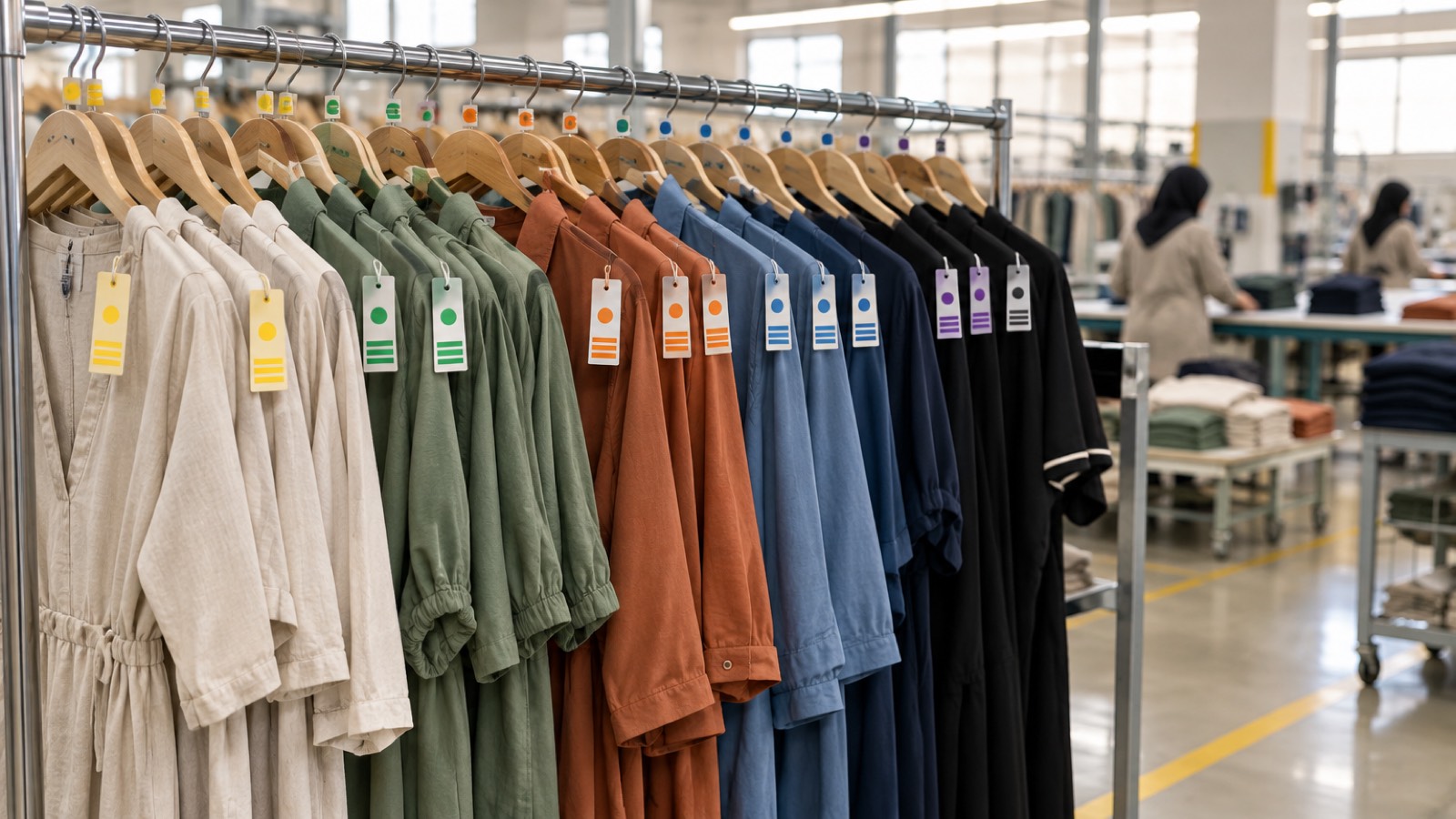
The colour segment only works if there is one list of colour codes and everybody uses it. "Navy", "dark blue" and "marine" must all map to NVY, or to three deliberately different codes if they really are different shades. Keep the colour list with a physical swatch card in the cutting room and the store.
Sizes need the same care. Decide once whether you write sizes as S/M/L/XL, as numbers like 38/40/42, or as age ranges for children's wear, and keep a single list. For mixed systems, such as a buyer who uses 2XL and another who uses XXL, choose one internal code and translate it on the buyer's documents. A size label list that matches your codes also makes trims and accessories much easier to control.
Rolling it out without stopping the floor
You do not need to recode every historical style on day one. A gradual rollout is safer:
- Agree the structure in one meeting with sales, pattern, cutting, production and the store. Write it on a single page.
- Apply it to all new styles from a fixed date. Give each new style its code at the moment it is approved, before any fabric is ordered.
- Recode only the active and repeat styles from your history, and keep the old name as an alias for a few months.
- Print the code on everything: the job card, bundle tickets, cutting reports, cartons and the delivery note.
- Appoint one person, usually in planning, as the owner of the code list. Nobody else creates codes.
That last point is what keeps the system alive. Codes created by many people drift quickly; codes owned by one person stay clean.
Where the code pays for itself
Once every department uses the same code, several things become possible that were difficult before. Tracking pieces from cutting through sewing to packing works because every movement refers to the same style and colour, which is the basis of tracking work in progress between stages. Costing becomes comparable between seasons, because PLS26014 and PLW26003 are clearly the same product type. And moving from spreadsheets to software stops being a painful data-cleaning project, which is one of the signs discussed in when to switch from Excel to factory software.
Returns, buyer complaints and audits also get faster. When a client in Milan emails about a stitching problem on "the navy polos from March", you can find the exact style, colour and size run in minutes instead of searching through notebooks.
How styles work in Nasij
Nasij keeps a styles list as the single reference for what the factory makes. Each production order is linked to a style, so material issues, stage movements and live balances all refer to the same record rather than to a name typed differently by each department. When you use a clear coding structure for those styles, the stage-by-stage balances and the Arabic PDF reports read cleanly for both your team and your clients. It also makes per-piece costing comparable across orders of the same style, which is where a good code quietly starts paying for itself.