Managing trims and accessories without running short
Ask any production manager in a garment factory what stopped a shipment last season, and the answer is rarely fabric. Fabric is expensive, so everybody watches it. The answer is usually something that costs a few piastres: the care label that was printed with the wrong composition, the 18 cm zipper that arrived as 16 cm, the last 400 buttons that nobody can find.
Trims and accessories typically make up 5 to 15% of the cost of a garment, but they can hold up 100% of the shipment. A finished, packed order without hangtags is not a finished order. This post covers a practical way to plan, receive, issue and count trims so the last carton is never waiting on the smallest item.
Why trims go missing
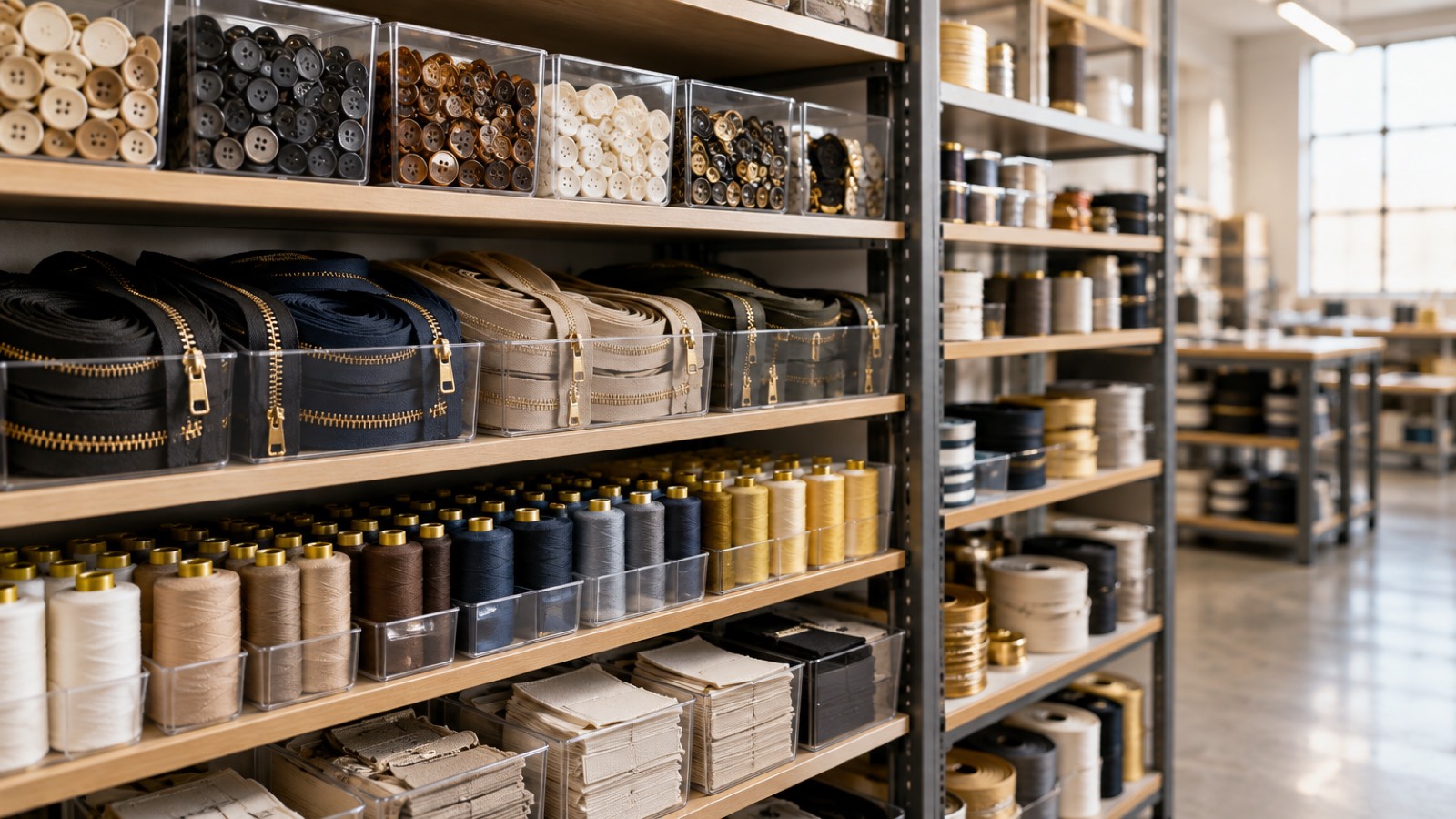
Trims fail differently from fabric. They are small, numerous and easy to borrow. A typical basic shirt might use 8 buttons, 1 main label, 1 size label, 1 care label, 1 hangtag, a polybag, tissue, a carton sticker and thread in two colours. That is ten or more line items per style, multiplied by sizes and colours. Common causes of shortages include:
- Ordering at exactly the bill-of-materials quantity, with no allowance for defects, sewing loss or replacement after repair.
- Informal borrowing between orders. Line 2 runs out of white buttons and takes a box from the order on Line 4. Nobody records it, and Line 4 discovers the gap three weeks later.
- Size and colour mix errors. The total quantity is right, but the split is wrong: plenty of size labels for M, not enough for XL.
- Late approval. Printed labels and hangtags depend on buyer approval, and their lead time quietly eats into the production window.
Build the trim requirement from the order, not from memory
The starting point is a trim sheet for each style: every item, its consumption per piece, and whether it varies by size or colour. From there the requirement is simple arithmetic plus an allowance.
Take an order of 6,000 shirts in three colours, with 8 buttons each. The net requirement is 48,000 buttons. Add an allowance for defects and loss, and order 50,400. The allowance should reflect the item, not a single blanket percentage:
| Trim type | Typical allowance |
|---|---|
| Buttons, snaps, rivets | 3 to 5% |
| Zippers | 2 to 3% |
| Sewn-in labels | 3 to 5% |
| Hangtags, stickers, polybags | 2 to 3% |
| Thread | 10 to 15% over calculated consumption |
Keep the trim sheet attached to the style itself, so the next repeat order starts from the same numbers. A consistent coding system for styles, sizes and colours makes this far easier, because a "size label, XL, navy" is then a precise item rather than a description someone has to interpret.
Receive trims the way you receive fabric
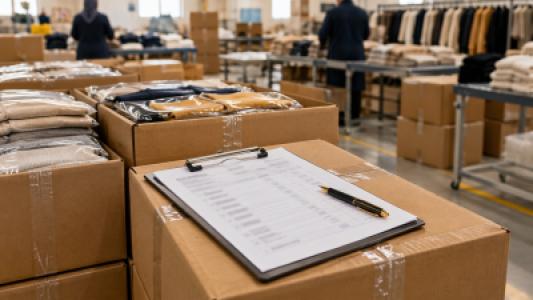
Trims deserve a proper intake, not a box left by the gate. When a delivery arrives, check it against the purchase order before it goes on the shelf:
- Count, or weigh and convert, the quantity. Buttons are often supplied by gross (144) and are faster to check by weight against a counted sample.
- Check the specification: size, colour against the approved swatch, and for labels the exact text, composition and country of origin.
- Check the size and colour split, not just the total.
- Record the intake against the purchase order on the same day.
A wrong care label found at intake is a reprint. Found at packing, it is a shipment delay, or a garment that cannot legally be sold in the destination market.
Issue trims against the order, and get the leftovers back
The single most effective control is simple: trims are issued to a specific production order, in the quantity that order needs, and nothing leaves the store without being recorded. Lines that need more must ask for it, and the request shows up as an additional issue against the same order.
This turns borrowing into a visible event. If Line 2 needs extra white buttons, the store can see that they are allocated to another order and decide whether to release them, rather than discovering the hole later.
Leftovers matter too. When an order closes, unused trims should go back to the store as a return, labelled with the order and style. Many factories have shelves of mixed leftover buttons with no record of what they are, which is wasted money and wasted space. Returning them properly is part of closing a production order correctly.
Count often, and count the right things
A full stock count once a year is not enough for trims. A better routine is a weekly cycle count of the items tied to orders that will ship in the next two weeks. Compare the physical count to the system balance, investigate any gap above a small tolerance, and record losses with a reason. The difference between "lost" and "damaged in sewing" changes how you fix the problem.
It also helps to watch a short list of numbers, in the spirit of the daily numbers every owner should see: open orders with any trim below requirement, trims still awaiting approval, and the trim loss rate per order compared with its allowance.
How Nasij helps keep trims in balance
Nasij treats trims as materials like any other, so the same movements apply. Each delivery is recorded as an intake against its purchase order, issues go to a specific production order, unused quantities come back as returns, and losses are logged with a predefined reason. Balances are live, so the store can see at any moment how many buttons are in stock and where the rest have gone. FIFO enforcement, in "block" mode if you choose, ensures older lots are used first so leftovers do not age on the shelf. When the order completes, purchase-order reconciliation compares what was received with what was issued, returned and lost, and that same data feeds your per-piece costing.