Preventive vs corrective maintenance for industrial sewing machines
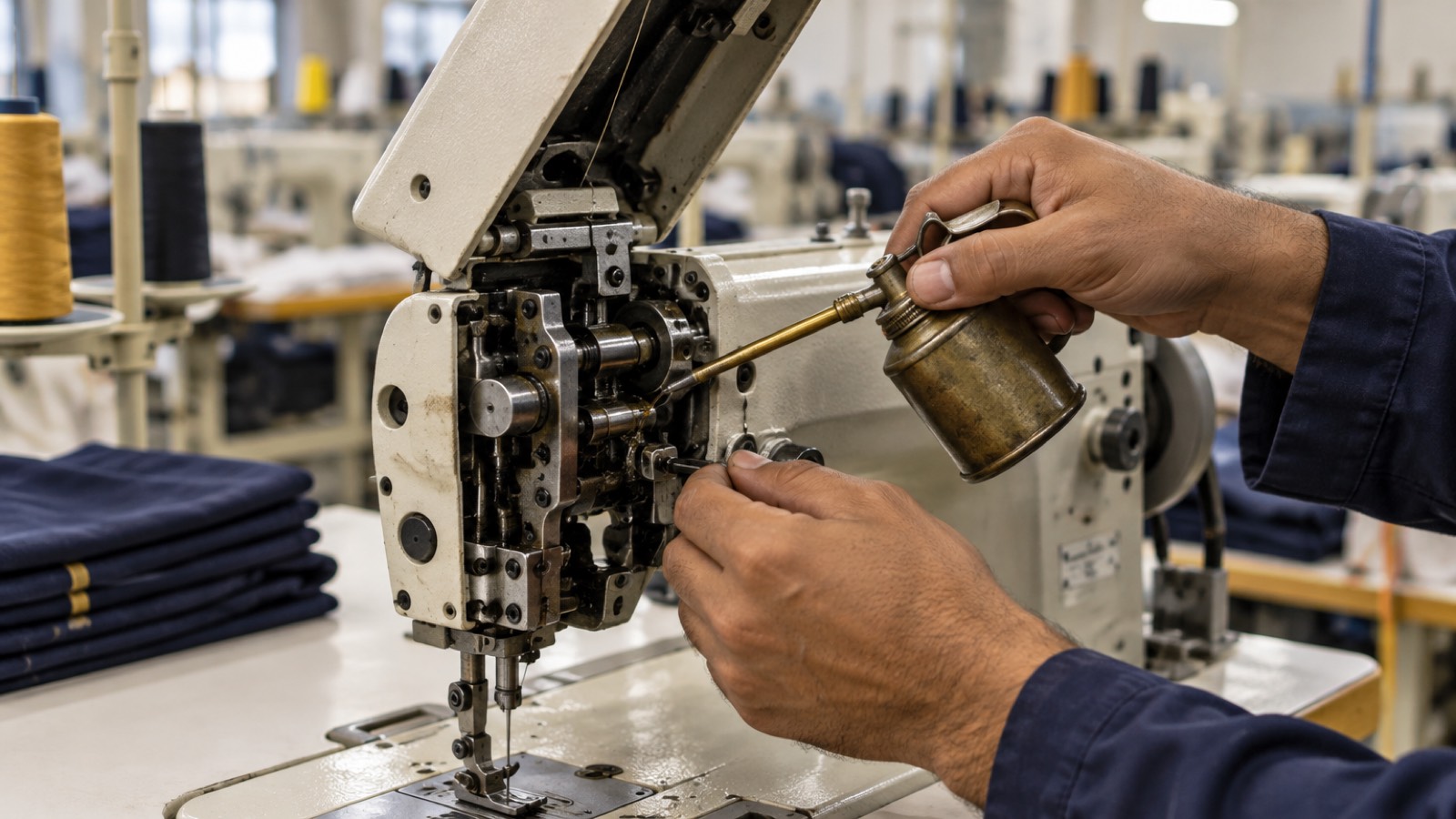
In most Egyptian garment factories, maintenance means one thing: a machine stops, the supervisor shouts for the mechanic, and the operator waits. That is corrective maintenance, and it is the default because it needs no planning. Preventive maintenance, by contrast, means oiling, cleaning, checking hook timing and replacing worn parts on a schedule, before anything breaks.
Neither approach is right for every machine. A factory that services everything weekly wastes mechanic hours on machines that never fail; a factory that waits for every breakdown loses whole hours of line output to a two-pound part. This article explains how to split your machines between the two approaches and how to make the split with data instead of habit.
What each approach really costs
The cost of a breakdown is rarely the repair itself. A worn feed dog costs a few hundred pounds; the real cost is the operators downstream who run out of work. Consider a line of 25 operators producing polo shirts. If the only overlock machine stops for 90 minutes, the side-seam operation stops, and within half an hour the operators after it are idle. Even at a modest loaded labour cost of 60 EGP per hour per operator, ten idle operators for one hour is 600 EGP, before counting the late shipment risk.
Preventive maintenance has its own cost: the mechanic's time and the planned downtime while the machine is serviced. A 20-minute weekly service on 40 machines is more than 13 mechanic hours a week. The question is never "which approach is better" but "for which machines does the planned cost beat the unplanned one".
A simple rule for splitting your machines
Most floors can classify every machine with three questions:
- Is it a single point of failure? If a line has one buttonhole machine, one bartack or one overlock, its breakdown stops everything after it. These machines go on a preventive schedule, no exceptions.
- Is there an identical spare nearby? If you have eight single-needle lockstitch machines and one standby, a breakdown costs the time to swap the operator to the spare, often under ten minutes. Running these to failure is acceptable.
- Does it fail in a predictable way? Machines with clear wear patterns, such as needle bars, loopers and knives on overlocks, respond well to scheduled replacement. Random electronic faults on servo motors do not, so preventive work adds little there.
This rule usually puts 20 to 30 percent of machines on a strict schedule and leaves the rest on a lighter routine of daily cleaning by the operator plus corrective repair.
What a realistic preventive schedule looks like
A schedule your mechanics will follow is short and specific. A typical one for critical machines:
| Frequency | Task | Who |
|---|---|---|
| Daily | Remove lint from the bobbin area and feed dogs, check the oil level | Operator |
| Weekly | Check needle and hook timing, thread tension, knife sharpness on overlocks | Mechanic |
| Monthly | Inspect belts, feed mechanism and presser foot pressure; replace worn loopers | Mechanic |
| Every six months | Full oil change, motor and electrical check | Senior mechanic |
Keep the daily task with the operator. It takes three minutes at the start of the shift and prevents a large share of skipped stitches and thread breaks, which are among the most common causes of stoppage. Our article on Pareto analysis of machine breakdown causes shows how to confirm which faults dominate on your own floor.
Let the breakdown history decide
The rule above is a starting point. After two or three months, the malfunction history should take over. A machine you classified as "run to failure" that has broken six times in a month deserves a schedule. A machine on weekly service that has not failed in a year can drop to monthly.
Two numbers make this decision easy. MTBF, the average running time between breakdowns, tells you whether a machine is failing more often. MTTR, the average time to bring it back, tells you whether the response is the problem. If you are not yet tracking them, read MTBF and MTTR explained for factory managers. For both, you need only the start and end time of each malfunction, recorded honestly at the machine.
The same history also tells you when no amount of maintenance will help. When repair costs keep rising on an old machine, the right decision is replacement, which we cover in the machine lifecycle from purchase to replacement.
Common mistakes to avoid
- Scheduling everything at once. Servicing all critical machines on Saturday morning stops several lines together. Stagger the schedule across the week.
- Logging repairs on paper. A notebook in the mechanic's pocket cannot be sorted, totalled or compared. If the history is not searchable, nobody uses it.
- Free-text fault descriptions. "Machine stopped" and "not working" tell you nothing. Use a fixed list of reasons so faults can be grouped.
- Ignoring the operator's early warnings. Unusual noise or heat usually appears days before a failure. Give operators an easy way to report it.
How Nasij supports this
Nasij records every malfunction against the specific machine, with its line, the style and operation being sewn, one or more reasons chosen from a predefined list, and the start and end time. Each machine carries a QR sticker, so a supervisor can scan it with any phone to open the machine's record and log a problem on the spot. Over a few weeks, the malfunction history shows which machines stop most often and for how long, and the machines that deserve a preventive schedule identify themselves. You still decide the schedule; Nasij gives you the evidence to decide it well. If your stickers are not printed yet, see QR stickers on every machine.