QR stickers on every machine: a 30-minute upgrade with year-long payoff
A medium-sized sewing factory in Egypt runs anywhere from 150 to 600 machines: single-needle lockstitch, overlock, flatlock, bartack, buttonhole, plus cutting and pressing equipment. Ask the maintenance supervisor where machine number 214 is today, when it last broke down and how many times it has been moved this year, and the answer usually starts with "let me check the notebook".
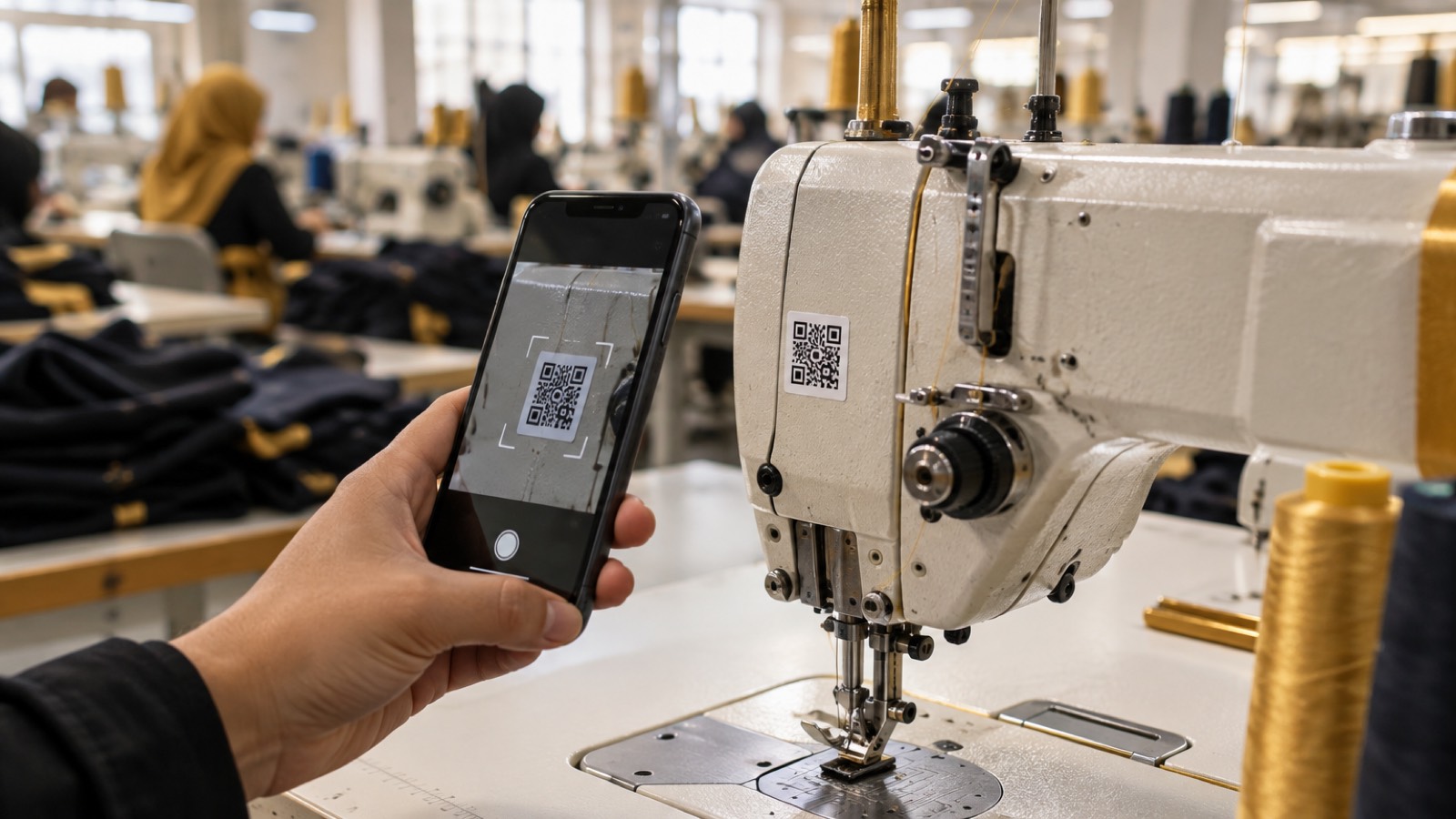
A QR sticker on every machine fixes the most basic part of that problem: knowing exactly which machine you are looking at. It is one of the cheapest upgrades a factory can make. Printing and applying stickers for a whole floor takes an afternoon, and the benefits show up every single day after that.
Why machine identity is the foundation
Most machine problems in garment factories are not technical; they are informational. A mechanic fixes "the Juki on line 3", but line 3 has eleven Jukis. A machine is moved from line 2 to line 5 for a new style and nobody updates the list. A repair is logged against a serial number that was copied wrongly. Months later, when you want to decide whether to repair or replace a machine, its history is scattered across three notebooks and a WhatsApp group.
Every useful maintenance metric, from breakdown frequency to repair time, depends on events being recorded against the right machine. Without a reliable identity on the machine itself, the data is guesswork. We explain those metrics in MTBF and MTTR explained for factory managers.
Printing and applying: the 30-minute part
The physical work is simple if you prepare properly:
- Clean up the machine list first. Make sure each machine has a unique code, a type, a brand and its current line. Fix duplicates before you print anything.
- Print in bulk. Generate one PDF with all stickers on A4 label sheets rather than printing one by one. A sheet of 24 labels covers a full line.
- Use durable material. Polyester or vinyl labels survive oil, heat and cleaning far better than paper. Laminated paper is an acceptable budget option.
- Pick a consistent position. On sewing machines, the right side of the head or the front of the table edge works well: visible, flat, and away from oil drips and the operator's hands.
- Apply line by line. One person reads the code on the sheet, another applies it and scans to check it opens the right machine. A team of two can label 80–100 machines an hour.
Include the human-readable machine code next to the QR code. When a phone battery is dead, people still need to read the number.
What the sticker unlocks every day
Once each machine carries a scannable identity, three daily workflows become faster and more reliable:
- Malfunction reporting. A supervisor scans the sticker with any phone, opens the machine's page and logs the breakdown with a predefined reason such as "thread breakage", "needle problem" or "motor". No one has to type a serial number.
- Machine transfers. When a machine moves between lines for a style change, the move is recorded against that exact machine, so the line inventory stays correct.
- Audits and counts. A periodic count becomes a walk down the lines scanning stickers, instead of comparing a printed list with what is on the floor.
From records to decisions
The real payoff comes after a few months of clean records. Consider a factory with 300 machines that logs around 90 breakdowns a month. After six months it has more than 500 events, each attached to a specific machine with a reason. That history answers questions that used to be opinions:
| Question | Before QR | After six months of QR logging |
|---|---|---|
| Which machines break down most? | "The old overlocks" | 12 specific machines account for 38% of breakdowns |
| What is the most common cause? | "Bad operators" | Tension and thread issues lead, then needle problems |
| Where is machine 214? | Unknown | Line 5, moved on 14 March |
With that history you can rank breakdown causes, a technique we cover in Pareto analysis of machine breakdown causes, and shift from reacting to failures to planning service, as discussed in preventive vs corrective maintenance. Over the longer term, the same records support repair-or-replace decisions across the machine lifecycle.
Common mistakes to avoid
- Printing stickers before the machine list is clean, then relabelling half the floor.
- Using paper labels that fade within three months near the pressing area.
- Placing stickers under the table where nobody can scan them without kneeling.
- Labelling machines but continuing to log breakdowns in a notebook. The sticker only pays off if every event goes through it.
The sticker itself costs a few piastres. The value is in the habit it creates: every event, every time, against the right machine.
How Nasij handles machine QR codes
In Nasij every machine record has its own QR code, and the full set can be bulk-printed as a PDF ready for label sheets. Scanning a sticker with any phone camera opens that machine, where the team can log a malfunction using the factory's predefined reasons or record a transfer between lines. Over time each machine builds its own history of breakdowns and moves, giving maintenance managers the data they need without extra paperwork.