The machine lifecycle: from purchase to replacement
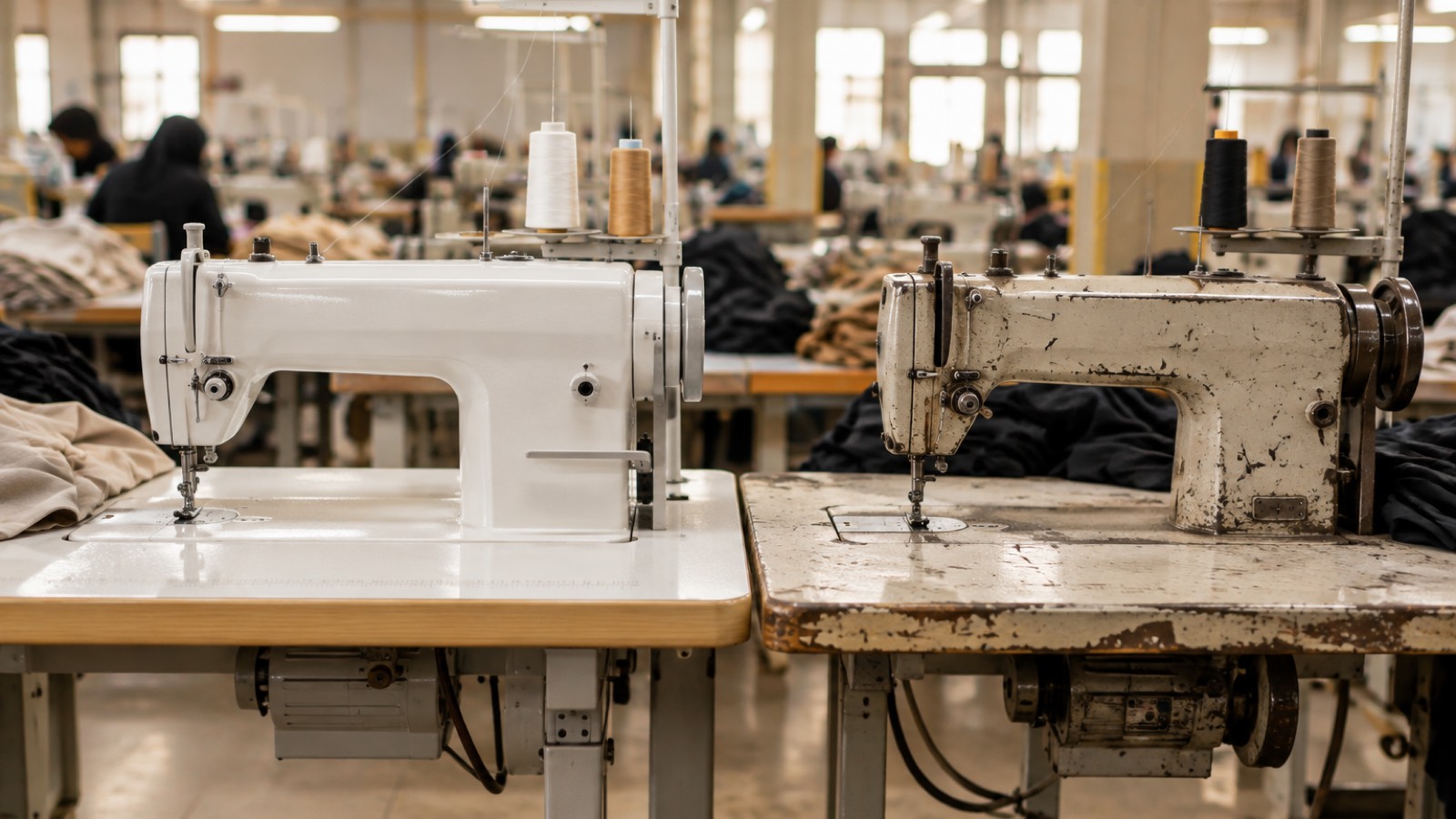
Every factory has them: the old lockstitch machines in the corner that "still work", the overlock that has been repaired so often the mechanic knows it by its serial number, the second-hand flatlock bought cheap three years ago that has cost more in repairs than a new one. Owners keep these machines because replacing them feels like an expense, while repairing them feels like saving money. Often it is the other way round.
Thinking of each machine as having a lifecycle, with stages you can recognise and measure, turns replacement from an emotional decision into a routine one.
The four stages of a machine's working life
- Purchase and installation. The machine arrives, is set up for your fabrics and operations, and goes through a short run-in period. Early faults are common here: wrong settings, a loose belt, a motor that was damaged in transport. These are usually covered by the supplier.
- Stable working life. Breakdowns are rare and mostly minor. For a good-quality industrial lockstitch, this period can last many years with basic care. Preventive maintenance does most of its value here, by keeping the machine in this stage longer.
- Wear-out. Breakdowns become more frequent and take longer to fix. Parts become harder to find, especially for older models. The machine still runs, but it runs less of the time, and stitch quality may drift.
- Replacement or redeployment. The machine is replaced, sold, kept as a spare, or moved to a less critical operation where its downtime matters less.
The expensive mistake is staying too long in stage three, because nobody has collected the numbers that justify moving to stage four.
The numbers that tell you which stage you are in
You do not need complicated accounting. Three figures per machine, reviewed every quarter, are enough:
- Breakdowns per month, and their trend. A steady rise over two or three quarters is the clearest sign of wear-out. This is the same idea as a falling MTBF, explained in MTBF and MTTR explained for factory managers.
- Downtime hours. Not just how often, but how long. Long repairs often mean parts are no longer easy to source.
- Repair spending. Parts and outside mechanic fees, kept against the machine.
The one-third rule
A practical rule of thumb used on many floors: when the cost of repairs plus downtime over the last twelve months approaches one third of the replacement price, start planning the replacement.
Here is an example. A computerised lockstitch costs around 30,000 EGP new. An old one on your line had 14 breakdowns last year:
| Item | Calculation | Cost (EGP) |
|---|---|---|
| Parts and repairs | Actual spend for the year | 3,500 |
| Operator idle time | 14 breakdowns × 2.5 h × 60 EGP | 2,100 |
| Downstream idle time | About 3 operators affected, half the time | 3,150 |
| Rework from poor stitching | Estimate from inline checks | 1,500 |
| Total | 10,250 |
At 10,250 EGP, the machine has crossed one third of its replacement price. Replacing it is no longer an expense to postpone; keeping it is. The figures will differ on your floor, so plug in your own labour costs, which you should already have if you follow a practical playbook for true per-piece costing.
What transfers between lines tell you
Machines move. A line switching from shirts to trousers needs a different mix, so machines are transferred between lines, and that is healthy. But transfer history also hides useful signals:
- A machine moved three or four times in a year, breaking down on every line, is probably genuinely worn.
- A machine that broke down repeatedly on one line and then ran smoothly after a transfer suggests the problem was on that line: an operator's habits, a heavy fabric, or the wrong setting for that operation.
- A machine that keeps being moved to the line nobody wants may be a quiet way of hiding a machine that should be retired.
None of these patterns are visible unless each machine's transfers and breakdowns are kept in one record.
Before you buy the replacement
A replacement is a chance to fix more than one machine. Before ordering, check:
- Standardisation. Fewer models on the floor means fewer spare parts to stock and faster repairs.
- Operation fit. Is the operation still needed in the same form, or would a different machine type, such as a programmable bartack, remove a manual step?
- Redeployment. The old machine may still be useful as a training machine for new operators, as described in training a new operator in two weeks, or as a standby on a non-critical operation.
- Identity from day one. Give the new machine its record and QR sticker on the day it arrives, so its history starts clean.
Keeping the history in one place with Nasij
Nasij keeps a record for each machine, with its brand, model and serial number, a QR sticker you can scan with any phone, every malfunction with its predefined reasons and start and end times, and every transfer between production lines. When the quarterly review comes, you are not chasing notebooks and memories; the breakdown trend and the lines the machine has served on are already in its record. Add your own repair spending and purchase price, and the one-third rule becomes a quick calculation rather than an argument. To decide which of your machines deserve scheduled care before they ever reach wear-out, see preventive vs corrective maintenance.