How to calculate SMV and line efficiency for a garment production line
"The line is slow today" is one of the most common sentences in any garment factory, and one of the least useful. Slow compared to what? A line of 30 operators that produces 700 polo shirts a day might be doing well or badly; without a reference, nobody can say.
Standard Minute Value (SMV) gives you that reference. It is the time a trained operator should need to complete an operation, or a whole garment, at a normal pace with normal allowances. Once you know the SMV of a style, you can calculate what a line should produce, measure how efficient it really is, and plan capacity with numbers instead of feelings.
What SMV is, and what it is not
SMV is a time standard, expressed in minutes, for a specific operation done by a specific method. Attaching a collar on a polo shirt might have an SMV of 0.85 minutes; the whole polo shirt might total 14.5 minutes across all operations.
SMV is not the fastest time your best operator can achieve, and it is not the average of whatever happens on the floor today. It is a standard: observed time adjusted for the operator's pace, plus allowances for fatigue, personal needs and small unavoidable delays such as thread changes.
The formula, step by step
For each operation, an industrial engineer or an experienced supervisor follows four steps:
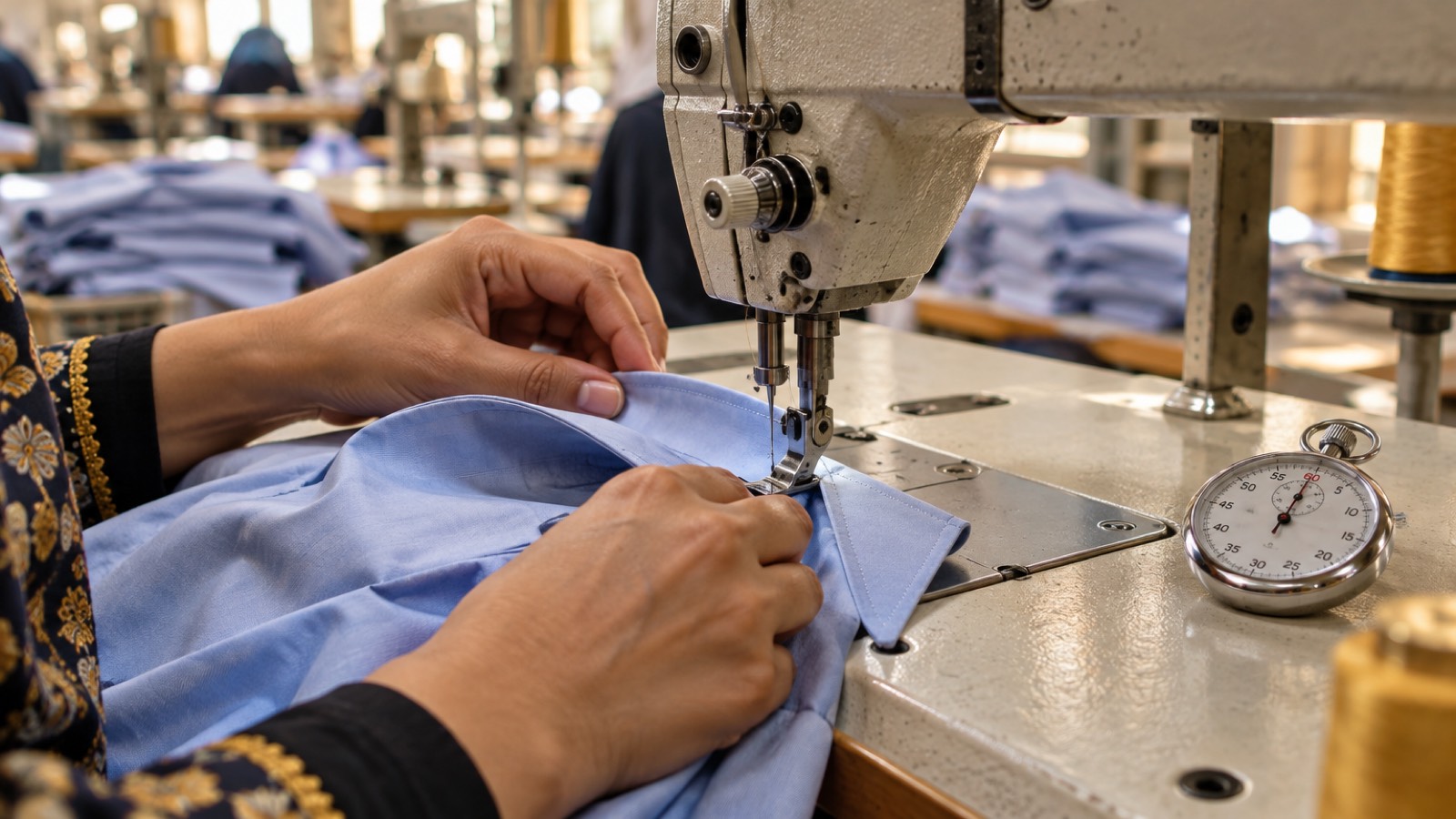
- Observe. Time the operation 10–15 cycles with a stopwatch and take the average. Discard cycles with obvious interruptions.
- Rate. Judge the operator's pace against a normal pace. A rating of 90% means the operator was slightly slower than standard; 110% means faster.
- Calculate basic time. Basic time = observed time × rating ÷ 100.
- Add allowances. SMV = basic time × (1 + allowance %). Allowances of 12–18% are common in sewing.
Example: an operator sets a pocket in an average of 0.62 minutes, rated at 95%. Basic time = 0.62 × 0.95 = 0.589 minutes. With a 15% allowance, SMV = 0.589 × 1.15 = 0.68 minutes. Add up all operations and you have the garment SMV.
Calculating line efficiency
Once you have the garment SMV, line efficiency compares the minutes the line produced with the minutes it was given:
Line efficiency % = (pieces produced × garment SMV) ÷ (number of operators × working minutes) × 100
Take a polo shirt with an SMV of 14.5 minutes, a line of 30 operators, and an 8-hour day of 480 minutes. The line has 30 × 480 = 14,400 available minutes.
| Daily output | Produced minutes | Line efficiency |
|---|---|---|
| 600 pieces | 8,700 | 60.4% |
| 700 pieces | 10,150 | 70.5% |
| 800 pieces | 11,600 | 80.6% |
| 993 pieces | 14,400 | 100% |
Many Egyptian factories run between 50% and 65% line efficiency, while well-managed lines on repeat styles reach 70–80%. Each 10 points on this line is about 100 extra polo shirts a day with the same people and machines.
Using SMV to plan and balance the line
SMV becomes really useful when you use it before production, not only after:
- Target output. At an expected 70% efficiency, the polo line should produce 14,400 × 0.70 ÷ 14.5 ≈ 695 pieces a day. That is a fair target for supervisors.
- Delivery planning. An order of 20,000 pieces at 695 per day needs about 29 working days on one line. You know this before accepting the delivery date.
- Line balancing. Divide the garment SMV by the number of operators to get a target cycle time. Operations that take much longer need extra operators or a split.
- Costing. Labour cost per piece follows directly from SMV and the cost of a minute in your factory.
A balanced line still depends on the stages before and after it. Our article on why the bottleneck is rarely where you think shows how to check that cutting and finishing can keep up.
Mistakes that make SMV lie
- Timing only the best operator. This gives an SMV nobody else can meet, and every line looks inefficient.
- Forgetting allowances. Without them, efficiency targets are physically impossible over a full shift.
- Counting rejected pieces as output. Efficiency should be based on good pieces, or a line can look efficient while producing rework.
- Ignoring lost time. Machine breakdowns, waiting for cut panels and style changeovers all reduce efficiency. Record them separately so you know whether the problem is people, machines or material.
- Using SMV to punish. Efficiency numbers lose their value the moment operators fear them. See measuring operator performance without demotivating your team.
SMV also links directly to pay and training. If you pay per piece, SMV is the fair basis for rates, as discussed in piece-rate pay vs fixed salary. And when you bring in new operators, SMV gives you a clear learning curve to track, as in training a new operator in two weeks.
Where Nasij helps
Nasij does not time operations for you; SMV still comes from your industrial engineering or supervisors. What Nasij provides is the other half of the efficiency formula: a reliable count of good pieces passed on by each stage, per style and per order, with losses recorded where they happen. Combine that output with your SMV per style, and line efficiency stops being a guess and becomes a daily figure you can trust.